A Precedence-Driven Approach for Concurrent Model Synchronization Scenarios using Triple Graph Gramm
summary
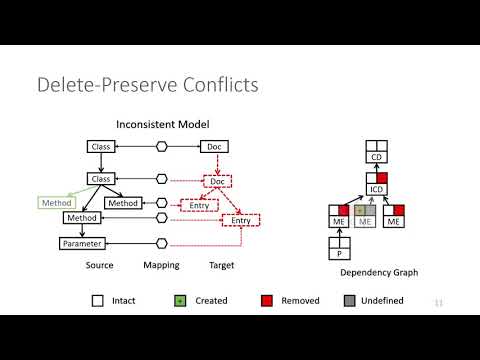
A precedence-driven synchronization approach based on triple graph grammars implements incremental, delta-based propagation in eMoflon and detects conflicts deterministically without modifying the models. It identifies specific conflicts such as delete-preserve conflict and correspondence preservation conflict (attribute conflicts are also supported) by traversing a dependency graph of rule applications, offers configurable resolution strategies, and preserves created elements. Evaluation on synthetic tests shows initialization scales linearly up to ~1.2 million nodes (100 concurrent changes) and conflict resolution scales linearly up to 2,000 changes on a 520k-element model.
AI-written summary · about
chapters (13)
- 0:00Intro
- 0:19Concurrent Modeling Editing
- 1:24Our Goal
- 2:10Triple Graph Grammar
- 3:27Consistent Model Generation
- 4:32Propagation Rules
- 5:35Conflict Detection
- 6:31Delete-Preserve Conflicts
- 7:56Correspondence Preservation Conflicts
- 10:01Orchestrated Conflict Resolution
- 11:59Implementation and Evaluation
- 12:55Evaluation Results
- 14:16Conclusion & Future Work
related talks
 26mTowards Efficient Model Comparison Using Automated Program Rewriting
 31mSynthesizing fine-grained synchronization protocols for implicit monitors
 18mAvoiding Conflicts in Highly-Concurrent Applications
 24mVerified Three-Way Program Merge
 01h 03mPrinciples of Persistent Programming
 25mResponsive Parallelism with Synchronization
 41mDesigning software with complex configurations
 25mDomain-specific model differencing in visual concrete syntax