Prototypes: Object-Orientation, Functionally

summary
Argues that prototype-based OO is more fundamental than classes and that the core fits cleanly into pure functional semantics: prototypes are functions that instantiate via fixed point and combine with an inherit as mixin composition operator; a simple Scheme implementation (about 30–50 lines plus lazy/delay) shows records-as-message-dispatch, wrappers that override or transform fields (example: start with x=1,y=2 then set x=3, double x, compute z=x+iy → 6+2i), and a constructive semantics that is both mathematically reasoned and runnable.
AI-written summary · about
chapters (12)
- 0:00Introduction and setup
- 1:02Defining object orientation
- 3:01Incrementality and modularity
- 4:56Debunking common misconceptions
- 7:39Foundational concepts
- 10:47Mechanics of the system
- 14:26Practical implementation example
- 17:26Inheritance and computation
- 20:03Conflation of instance and prototype
- 22:43Classes and meta-levels
- 25:46Synthesis and conclusions
- 28:46Q&A and session wrap-up
related talks
 51mFunctional Principles for Object Oriented Development
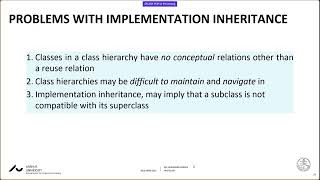 38mWhat Object-Oriented Programming Was Supposed to Be: Two Grumpy Old Guys’ Take on ...
 45mFunctional programming vs. Object-oriented Programming
 32mThe Evolution of Object-Oriented Programming
 01h 00mDynamic Polymorphism with Metaclasses and Code Injection
 27mObject Oriented Programming Best Practices
 53mOOP vs FP
 52mParadigms Lost, Paradigms Regained: Programming with Objects and Functions and More