Twenty Years of JRuby
summary
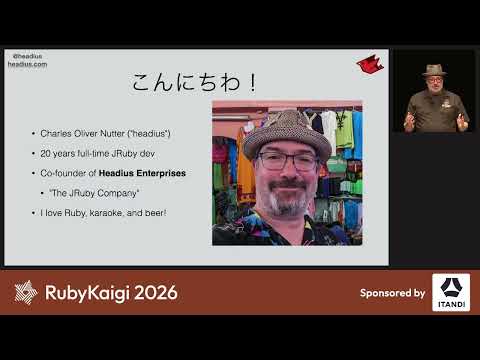
Twenty years of work on JRuby produces concrete wins: JRuby 10.1 released with a core object layout reduced to 24-byte objects and short Fixnum storage, a JIT since 2008 and JVM invokeDynamic support in 2011, Rails first routes in 2006 (dev 10–15s, production fast), and real parallelism where JSON parsing scales to 20x on 20 cores. Production users include Logstash and easyBI, and JVM libraries like JFreeChart integrate with zero native gems.
AI-written summary · about
chapters (11)
- 0:00Introduction and background
- 7:03First encounter with Ruby
- 10:14Road to Rails and JRuby
- 15:54First Rails request and JavaOne
- 17:24Building JRuby from scratch
- 19:30JIT compiler and JVM integration
- 22:41JVM advantages for JRuby
- 26:16Garbage collection and concurrency
- 30:01Java library integration
- 33:55JRuby 10.1 release and future
- 42:41Call to action and conclusion
related talks
 53m20 Years of JRuby - Where We've Been and Where We're Going
 39mJRuby: Insights from Six Years in Production
 55mJRuby in 2018: Building, Deploying, and Scaling Your Apps
 42mJRuby at 15 Years: Meeting the Challenges
 40mJRuby 2018: Real World Performance
 31mExpand your Ruby Potential with JRuby
 47mWhy JRuby Works
 39mJRuby on Rails: From Zero to Scale