Rails Upgrade Mastery: Best Practices for Large-Scale Enterprise Applications
summary
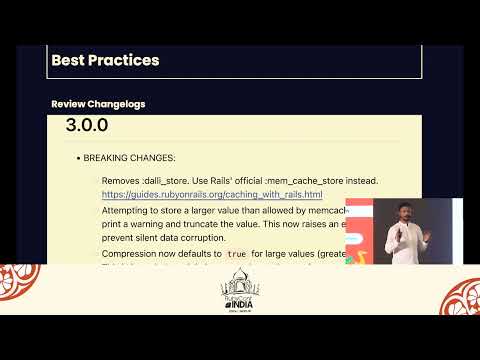
Enterprise Rails upgrade strategy that actually names tradeoffs and tools: a codebase started on Rails 1 with ~1,000 developers, ~500 gems and 4,000 customers uses production‑like performance gate testing and two upgrade paths — long‑running branch or dual boot via boot gem and gemfilenext. The team sees 17,000 test failures out of 125,000 then narrows them by grouping common stack traces to ~50, reviews changelogs and patched gems, fixes transaction semantics and runs perf suites until metrics stabilize.
AI-written summary · about
chapters (11)
- 0:00Introduction to Rails upgrades
- 2:47Why upgrade Rails versions
- 5:28Choosing the right Rails version
- 6:57Pre-upgrade considerations
- 8:02Reviewing changelogs and patches
- 11:22Production-like performance testing
- 12:26Version jumping strategies
- 13:30Long running branch strategy
- 14:57Dual booting strategy
- 17:49Handling test failures
- 20:38Summary and recap
related talks
 29mUpgrading Rails at Scale
 33mUpgrading a big application to Rails 5
 35mChanging the wheels on the bus at 80 mph: Upgrading to Rails 3
 28mUpgrading Rails: The Non-Technical Parts
 25mUpgrading Rails: Everyone can do it and here’s how
 36mRuby & Rails Versioning at Scale
 39mThe Long Ball - Upgrading long lived Rails apps from 1.x-4.0
 36mRuby & Rails Versioning at Scale