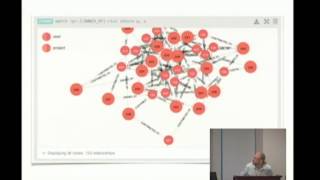
Our daily graphs written in Ruby and Neo4j

summary
Argues that relational tables choke on networked data and shows a working Ruby + Neo4j setup used to model Brazilian hydropower plants so failover decisions drop from minutes to under 30 seconds by traversing topology instead of joining tables. Uses Ruby + Neo4j via Neography and queries with Cypher traversal, stores edge attributes like line voltage, and warns about operational costs — clusters require lots of memory (almost 100 GB RAM), backups and monitoring add complexity.
AI-written summary · about
chapters (11)
- 0:00Introduction and welcome
- 1:11Why talk about graphs
- 4:49Graphs in real-world systems
- 8:07Relational model struggles
- 13:11Graph databases as solution
- 16:46Graph traversal benefits
- 18:09Cypher query language
- 19:34Ruby integration options
- 21:03When not to use Neo4j
- 22:53Infrastructure considerations
- 23:14Summary and closing