"React integration into existing Rails applications"

summary
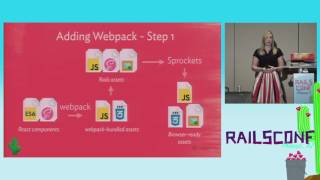
Covers three options: use the react-rails gem for quick insertion, use react_on_rails for full server rendering and npm module support, or build a client/webpack approach (client folder, package.json, webpack entry/output) that generates a bundle consumed by the asset pipeline. Shows passing Rails data as JSON props into a global mount method in an inline script, advises moving build deps into dependencies for Heroku, and explains migrating from ERB hybrid pages to a SPA + Rails API and optional server-side rendering.
AI-written summary · about
chapters (10)
- 0:00Introduction and speaker intro
- 1:31Three ways to integrate React
- 4:04Why choose React
- 7:49Custom React setup in Rails
- 10:16Legacy app integration challenges
- 13:23Webpack configuration basics
- 15:57Passing data from Rails to React
- 19:25Final custom integration example
- 21:58Benefits of separate client app
- 23:23Future steps and Q&A
related talks
 31mReact.js on Rails
 36mFront-End Sadness to Happiness: The React on Rails Story
 31mReact on Rails
 18mReact-ing to Rails: Why Ruby on Rails is the best Stop for Web Developer
 28mOverreacting—From React to Hotwire
 47mActionCable, Rails API and React - Modern Single Page Apps
 34mFrom Sprockets to js-bundling: Evolution of JavaScript tooling in Rails!
 23mReact-ing to Hotwire