Quantum Obfuscation of Classical Circuits
summary
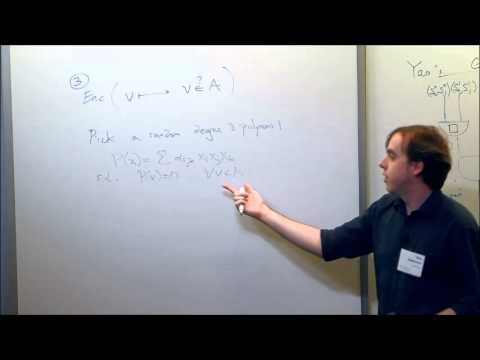
Proposal maps a classical circuit to a single quantum state that can be used to evaluate the function while (plausibly) leaking no more than black‑box access. Construction uses garbled-circuit-style subspace secrets: each wire corresponds to two sparse linear subspaces, and a quantum token is a uniform superposition over a subspace so measuring position or Hadamard-measurement yields one secret but collapses the token. Membership tests are hidden by degree-3 polynomials as membership obfuscation. Security rests on query‑complexity lower bounds and remains conjectural; non‑copyability and one‑time‑like behavior are claimed.
AI-written summary · about
chapters (10)
- 0:00Quantum black box goals
- 3:35Garbled circuit framework
- 7:10Quantum one-time programs
- 8:02The obfuscation plan
- 10:30Subspace-based secrets
- 14:35Implementing secret extraction
- 17:45Membership oracles
- 23:10Security analysis challenges
- 25:04Gate transformation methods
- 28:11Final protocol construction
related talks
 59mAn Introduction to Quantum Obfuscation
 46mObfuscation of Unitary Quantum Programs
 01h 03mFrom Program Obfuscation to Unclonable Cryptography
 01h 08mNew Quantum Cryptographic Primitives II
 48mBlack-Box Separations in Quantum Cryptography
 16mQuantum Information Meets Cryptography
 01h 04mTutorial on obfuscation
 01h 26mQuantum FHE