Skrub: machine learning for dataframes
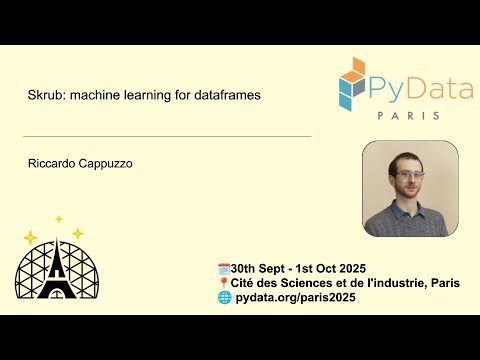
summary
Skrub claims to convert Pandas/Polars tables into scikit‑learn ready feature matrices with minimal code and reproducible operations; it supplies concrete tools: table vectorizer that auto‑assigns encoders (default switch at 40 uniques), datetime and squashing scaler transformers, TF→SVD string encoder and optional HuggingFace text encoders, plus a tracked data ops plan that persists learners and emits an offline HTML report — demos run end‑to‑end and show hyperparameter search and replay working.
AI-written summary · about
chapters (15)
- 0:00Introduction
- 1:05What is Scrub
- 3:10Exploring data with table report
- 5:15Cleaning data with Scrub
- 6:18Encoding date and time
- 7:20Scaling numerical features
- 8:23Encoding categorical features
- 9:26Vectorizing tables
- 10:29Building predictive pipelines
- 11:53Handling multi-table data
- 13:40Creating DataOps plans
- 16:05Saving DataOps workflows
- 17:09Tuning DataOps operations
- 18:57Resources and getting started
- 20:47Q&A
related talks
 19mSkrub: Less data wrangling, more machine learning
 20mSkrub DataOps, Probabl
 35mPandas, Pipelines, and Custom Transformers
 30mKick-Start your Understanding of Machine Learning with Python
 21mPolars: A highly optimized dataframe library
 32mMachine Learning Infrastructure at Stripe: Bridging from Python JVM
 35mScikit-Learn can do THAT?!
 33mUsing Scikit-Learn's interface for turning Spaghetti Data Science into Maintainable Software