Sentiment Analysis, its techniques and applications

summary
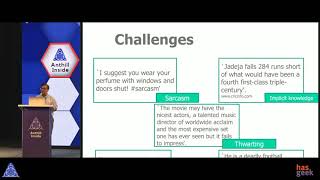
Overview of practical sentiment work using NLTK movie reviews corpus for a Naive Bayes baseline that reaches about 72% accuracy, moving to distributed embeddings like Word2Vec/GloVe vectors and CNNs in TensorFlow for higher scores but less interpretability. Challenges are sarcasm, SMS shorthand and annotator disagreement (human agreement often ≤80%). Applications include topic/aspect extraction and healthcare: a depression-detection pipeline reports ~81% depression detection and is used to flag cases for further intervention.
AI-written summary · about
chapters (9)
- 0:00Intro
- 1:02Introduction: Natural Language Processing
- 2:28Introduction: Sentiment Analysis
- 6:29What are the challenges?
- 8:27Simple things you can do with NLTK
- 12:27Feature Vectors
- 15:40Using dictionaries and modules
- 18:36Sentiment labelling and classification methods
- 25:07Uses and types of sentiment analysis
related talks
 01h 23mBeyond Sentiment Emotion Mining with Python and machine learning
 01h 31mAn Introduction to Sentiment Analysis of...
 39mThe art and science of making computers understand sentiment and emotion
 43mSentiment Analysis in Action: Building Your Real-time Pipeline
 01h 28mSentiment Analysis with Deep Learning, ML or Lexicon Based
 59mTechnical Workshop: Sarcastically Speaking: Unlocking Multi-modal Sentiment Analysis With NLP and Facial Expressions
 01h 05mSocial Text, Sentiment, and Tone Analysis
 43mGetting Sentimental: exploration of iOS sentiment analysis