Graphical Primitive Recursion For String Diagrams

summary
Provides a concrete way to add primitive recursion to diagrams in a symmetric monoidal setting, with a proof‑of‑concept Haskell eDSL that converts recursive diagrams into runnable circuits and compiles down to KASM. Defines two formal semantics — translation to endofunctor algebras enabling paramorphisms (so recursive boxes keep their index and admit algebraic laws) and an alternative view as a composition of coends. Demonstrates by encoding the Quantum Fourier Transform, running and simplifying mirrored/inverse circuits automatically using the paramorphic equations.
AI-written summary · about
chapters (10)
- 0:00Introduction
- 1:07Scalable ZX calculus
- 2:35Quantum Fourier transform example
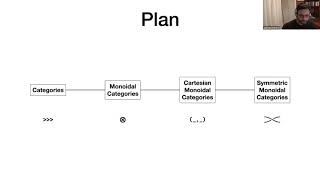
- 5:01Semantics in symmetric monoidal categories
- 8:13Recursion schemes and paramorphisms
- 12:57Paramorphic semantics for diagrams
- 14:21Haskell implementation
- 15:47Applications and future work
- 16:30Live QFT code
- 17:12Q&A
related talks
 56mAn introduction to recursion schemes
 37mGoing bananas with recursion schemes for fixed point data types
 14mThe Simple Essence of Monomorphization
 25mRecursive Program Synthesis using Paramorphisms
 31mA tour of String diagrams and Monoidal categories
 31mAbstract your representation and fix your functors
 01h 02mGoing bananas with recursion schemes for fixed point data types
 15mA systematic approach to "Well-founded recursion done right"