Database Hardware Selection Guidelines
summary
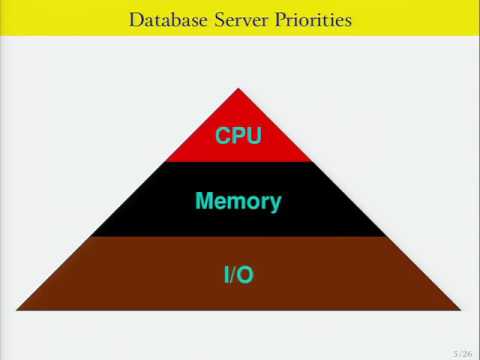
Benchmarking with pg_test_fsync shows real differences: an SSD with proper power protection delivers about 6000 fsync/s vs 80 fsync/s for a magnetic drive with cache disabled. Practical rules: use battery-backed HBA or enterprise SSDs, avoid RAID5/6 (prefer RAID10), run ECC RAM, size memory to hold ~five minutes of working set, run smartd/iostat/free to spot I/O or memory pressure, and on cloud use provisioned IOPS. Tuning: move XLOG, prefer XFS, and lower random_page_cost for true SSDs.
AI-written summary · about
chapters (13)
- 0:00Introduction and philosophy
- 4:18Rethinking server architecture
- 7:07Why databases are unique
- 7:58Hardware bottlenecks
- 13:29The role of the IO stack
- 17:49Testing storage performance
- 21:22Ensuring data durability
- 27:26Caching and RAID strategies
- 28:11Storage monitoring and health
- 31:30Optimizing SSD usage
- 35:29Shared storage and cloud
- 43:46Memory and CPU considerations
- 49:20Conclusion and Q&A
related talks
 50mPostgres vs. Linux filesystems
 45mBig Data and SSDs
 25mPerformance Analysis of NVMe SSDs and their Implication on Real World Databases
 29mMySQL Performance for DevOps
 36mBest Practices in PostgreSQL Tuning: Navigating Key Performance Bottlenecks in the Cloud
 43mPostgreSQL in the cloud: Theory and Practice
 25mVindicating ZFS with PostgreSQL: Unleashing the Power of Scalability
 35mQuestioning Database Claims: Design Patterns of Storage Engine