Akka in Production: Our Story
summary
Company processes 2.5 billion events a day and details a path from early Akka experiments to a simple, reliable pipeline that reads from Kafka, stages with actors, and writes to Cassandra; teams try Spray HTTP endpoints, Akka Cluster when experimental, and then moved away from Storm to avoid hard-to-debug supervisors. Practical choices include Logback for dynamic log levels, bounded mailboxes and pull-based flow control, VisualVM CPU sampling for production hotspots, and an actor-stack trait pattern that actually made instrumentation and debugging work.
AI-written summary · about
chapters (19)
- 0:00Gold Sponsor
- 0:16Silver Sponsors
- 0:50Who is this guy?
- 2:31COMPANY OVERVIEW
- 3:06How we started using Scala
- 5:25Livelogsd - Akka/Kafka file tailer
- 6:16Storm - with or without Akka?
- 8:21Akka Cluster-based Pipeline
- 11:41Simplified Ingestion Pipeline
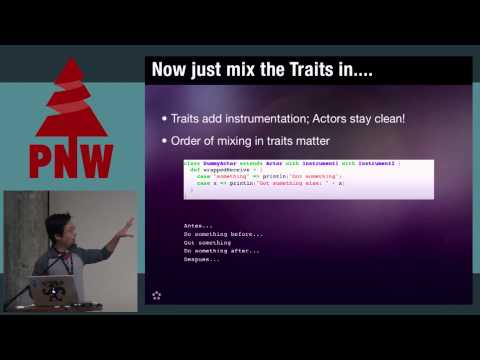
- 12:52Why Stackable Traits?
- 13:45Start with a base trait...
- 14:41Instrumenting Traits...
- 16:01Our Akka Stack
- 16:59Using Logback with Akka
- 19:09Akka Performance Metrics
- 23:35Flow control (Cont'd)
- 24:25VisualVM and Akka
- 25:57Tracing Akka Message Flows
- 38:11Akka Visibility, Minimal Footprint
related talks
 55mExperience report on using Akka in production: pitfalls and rewards
 51mComposing high performance process workflows with Akka Streams
 56mAkka in Heterogenous Environments
 52mThe best is yet to come - State of Akka in 2017
 48mThe three paths of Scaling with Akka
 44mAkka post-mortem in a microservice architecture
 58mLife with actors: experience report
 44mLong-lived microservices