OpenStack in Telco: How to achieve Low latency computing with OpenStack

summary
Shows a concrete OpenStack deployment using TripleO, the PREEMPT_RT kernel, KVM with real-time guests and libvirt tuning, plus CPU isolation, vCPU pinning and hugepages configured in Nova flavors. Runs 24‑hour latency tests (single‑VM then multi‑VM) and measures response tails, enforcing a 40 microseconds max bound for interrupt and scheduling latency. Provides the actual test setup, tools, and pass/fail numbers so you can judge whether the build meets telco real‑time needs.
AI-written summary · about
chapters (8)
- 0:00Intro
- 0:44What's Low-latency?
- 4:15Real-Time KVM(RTKVM)
- 5:53How to achieve Low-latency with RT-KVM in OpenStack?
- 7:443.1 Realtime pre-requisites for compute nodes
- 8:423.1 Real time pre-requisites for compute nodes → Software Real Time packages install
- 12:563.3 Real-Time VM Setup
- 13:363.4 Config nova
related talks
 26mRun your Kubernetes cluster on OpenStack in Production
 41mCloud Computing with KVM
 39mEvaluation of PREEMPT_RT in Virtualized Environments
 32mExtending Network Quality of Service support in OpenStack
 26mReal-time Linux: what is next?
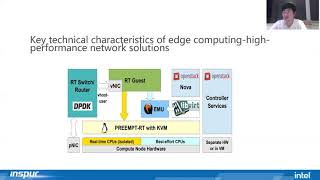 25mDPDK performance optimization for edge computing scenario
 26mPower Management for Telco Operators
 28mCloud Control to Major Telco