Late Interaction Retrieval in Practice: Implications for OpenSearch-Based Search Systems

summary
Late interaction retrieval is practical as a rescoring stage in OpenSearch: documents store one pooled canonical vector for ANN indexing and separate token vectors kept as nonindexed objects, queries pool a query vector then expand candidates 10x and apply token-level max-sum scoring. A recent cold bandit algorithm reduces token comparisons and reports about 5x fewer computations with nDCG@10 unchanged and overlap@10 >0.9. OpenSearch 3.3 adds a native late-interaction score field and mappings for canonical + multivector storage.
AI-written summary · about
chapters (6)
- 0:00Late interaction retrieval intro
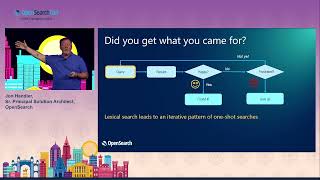
- 1:03Three retrieval interaction levels
- 7:03Optimization for late interaction
- 8:33Cold bandit algorithm
- 13:54Late interaction in OpenSearch
- 16:40What’s coming next in OpenSearch
related talks
 52mBeyond Single Vectors: Multi-Vector Search for Enhanced...
 20mChallenges in Building RAG Systems (and Solutions Using OpenSearch)
 36mOptimizing LLM Performance With Caching Strategies in OpenSearch
 47mBoosting AI With OpenSearch: Vector Stores, Similarity Search, and Retrieval-Augme...
 46mNatural Language & Search, Improve your Search w/ Vector capabilities
 44mRediscover your keyword search: Expand, Enrich and Rewrite
 42mIntegrating Graph Context With OpenSearch for Enhanced RAG Application Performance
 45mRevolutionizing Search with Power of Neural Sparse and Dense Vectors