How to take your Kubernetes cluster to next level with Karpenter, Ray and Amazon EKS?
summary
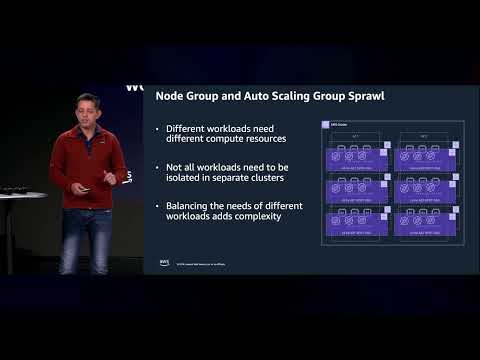
Kubernetes on EKS combines Karpenter for node autoscaling and Ray for distributed Python workloads so clusters scale automatically and cost‑efficiently. Karpenter auto-provisions the right EC2 types, prefers Spot then falls back to on‑demand, and does drift detection with rolling node upgrades, removing hundreds of manual autoscaling groups; example customer runs 100,000 microservices and handles Prime Day bursts (300M items/day, peaks ~100k/min). Ray shards Python pipelines across many VMs for data processing or training (e.g., ~50 A100 GPUs over 35 days for a large model) and integrates with EKS. Karpenter auto-provisions cost-optimized nodes Ray distributes Python pipelines across 20+ VMs
AI-written summary · about
chapters (7)
- 0:00Introduction and use case
- 2:36Kubernetes and Amazon EKS
- 5:15Autoscaling with Karpenter
- 12:16Workloads on Kubernetes
- 15:37Distributed computing with Ray
- 21:55Resources and call to action
- 22:48Q&A session
related talks
 40mOptimize EKS Cost and Scaling with Karpenter
 31mKubernetes workloads with Karpenter & Amazon EKS
 42mOptimize Amazon EKS workloads for performance and cost
 01h 01mJust-in-time Nodes for Any AWS EKS Cluster: Karpenter
 38mScaling EDA Workloads with Kubernetes, KEDA & Karpenter
 22mUse Karpenter to scale, optimize & upgrade K8s
 27mHarness the power of Karpenter to scale, optimize & upgrade K8s
 22mKarpenter Efficient scaling of Kubernetes clusters