Scalable Spreadsheet-driven End-User Applications with Incremental Computation

summary
Claims a compiler converts a spreadsheet table into a program that ingests a stream of edits and emits delta updates so aggregations (sums, AVG, filters) update in time proportional to the change, not table size. Implementation uses an offline phase that builds column-level graphs, read-sites (Pi), Q-inverses and E_y sets, and an online phase that applies deltas; handles horizontal, incremental and arbitrary dependencies. Evaluation uses a 6,215-spreadsheet benchmark across four modes and shows much lower memory than full cell graphs while faster updates with delta enabled.
AI-written summary · about
chapters (16)
- 0:00Spreadsheet-driven applications intro
- 1:45Large spreadsheet challenges
- 3:14Sper framework intro
- 6:49Incremental dependencies in formulas
- 8:57Read sites and affected objects
- 11:46Algorithm for affected cells
- 14:34Dependency graph construction offline
- 15:40Incremental updates with graph
- 17:08Benchmark results
- 19:59Solution summary and advantages
- 21:29Q&A: Spreadsheet granularity
- 22:51Q&A: Row/column insertions
- 23:58Q&A: Compile-time overhead
- 25:25Q&A: Beyond aggregation formulas
- 26:51Q&A: Dependency graph precision
- 28:40Closing remarks
related talks
 06h 54mTopical Edition on Databases - Track 1
 36mData Driven UIs, Incrementally
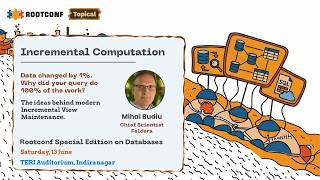 49mIncremental Computation
 34mConstraint Logic Propagation Conflict Spreadsheets
 01h 10mReal World Iterative Database Development
 33mA (Semi)Ring-Based Query Algebra for Incremental View Maintenance and Query Compilation
 12mEmpower your dataSources with a flexible model
 17mOptimizing Data-Driven Decisions