On gradient-based methods for finding game-theoretic equilibria

summary
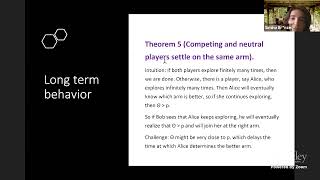
Matches a learning multi-armed bandit problem to a matching market where choices are exclusive so only one agent wins each arm, models agents exploring unknown preferences on both sides, and runs UCB-Gale Shapley by feeding upper confidence bounds into a Gale–Shapley matcher. The paper proves the algorithm achieves logarithmic regret (near-optimal) and quantifies agent interaction via a Δ^2 interaction term, presenting formal theorems and worked analysis rather than just examples.
AI-written summary · about
chapters (4)
related talks
 28mMultiplayer Bandit Learning - From Competition to Cooperation
 29mNash-Bargaining-Based Models for Matching Markets: One-Sided and Two-Sided; Fisher and Arrow-Debreu
 22mOnline Learning and Bandits with Queried Hints
 27mOn the Complexity of Best Arm Identification in Multi-Armed Bandit Models
 12mLearning In The Presence Of Strategic Agents: Dynamics, Equilibria, And Convergence
 56mOf Moments and Matching: Trade-offs and Treatments in Imitation Learning
 01h 11mA Theory of Multi-objective Machine Learning
 Bandits and Agents: How to Incentivize Exploration?