Angular in a Microservices World

summary
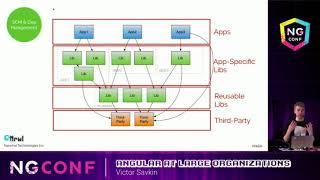
Argues that replacing repeated front-end mini‑monoliths with a modular Angular mono‑repo fixes compatibility and duplication: one package.json enforces a single Angular version, libraries live in apps/libs with create-nx-workspace and TS path mapping, TS‑Lint rules enforce public APIs and module boundaries. Builds use a dependency graph and affected builds so CI only rebuilds and tests projects impacted by a change. The example e‑commerce workspace compiles and the graph + affected logic work as claimed.
AI-written summary · about
chapters (18)
- 0:00Intro
- 1:50About me
- 2:51Runtime
- 3:32Shared Process
- 4:12Deployment Overview
- 7:17Mono Repo
- 10:36Narwhal
- 11:38Example Frontend
- 12:39Create Annex Workspace
- 16:25Schematics
- 17:00Importing
- 18:12TS Lint Rules
- 20:05Define Relationships
- 23:34Building
- 26:05Summary
- 26:35Quote
- 28:01Mono repos
- 29:42References
related talks
 33mArchitectures for huge Angular based Enterprise Applications: npm Packages, Monorepos and Microservices
 34mAngular Monorepo Diaries
 20mArchitectures for huge Angular based Enterprise Applications...
 35mHow to Organize an Angular Project
 22mSustainable Angular Architectures with Monorepos and Strategic Domain Driven Design
 01h 00mUsing Monorepos for Scalable Apps
 21mSustainable Angular Architecture
 25mAngular at Large Organizations