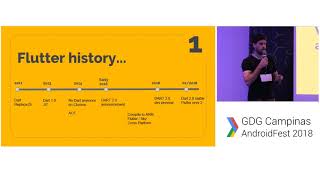
Why is Flutter the mobile SDK developers deserve...

summary
Flutter compiles Dart to native ARM code (AOT) and also uses JIT for stateful hot reload, letting UI changes apply without losing app state; the demo builds an app with app bar, drawer and FAB in ~2:09 and changes appear on both iOS and Android simultaneously. The engine ships Skia so Flutter draws everything on the screen (no webview, no JS bridge), yielding 1.8× faster development, ~50% less code, but a ~4.7 MB baseline binary and incomplete third‑party coverage; Alibaba, Google Ads and Hamilton cite production use and native plugin interop via method channels.
AI-written summary · about
chapters (18)
- 0:00Introduction and speaker intro
- 1:46Why Flutter now and market stats
- 3:34Cross-platform frameworks comparison
- 6:22Developer pain points and Flutter's role
- 8:08Dart language simplicity and ease
- 9:10Consistent UI across platforms
- 10:15Runtime drawing and customization
- 13:03Native performance with AOT compilation
- 16:47Live coding demo and speed test
- 21:26Hot reload and stateful development
- 23:13Performance promises and frame rates
- 24:17IDE support and Firebase integration
- 25:23Real-world Flutter adopters
- 27:04Everything is a widget in Flutter
- 28:33Flutter's limitations and challenges
- 31:04Future platforms beyond mobile
- 32:08Learning resources and community
- 34:55Closing and designer freedom