Kotlin for Data Science
summary
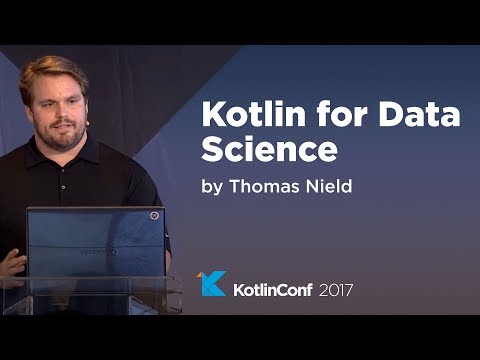
Argues Kotlin closes the gap between data science and production code by using JVM libraries and concise syntax, shows an ojAlgo linear solver scheduling model that assigns three drivers and reports a $936 minimum-cost schedule, demonstrates a Kotlin-Statistics library that does k-means clustering and grouping/ binning (counts and average defect rates), notes interop with Apache Spark, Krangl and ND4J, and builds a small TornadoFX desktop UI to visualize clusters and tables.
AI-written summary · about
chapters (19)
- 0:00Introduction
- 1:55What is Data Science
- 7:00Challenges in Data Science
- 11:55Why Kotlin
- 13:00One Language One Code
- 13:37Kotlin vs Python
- 14:04Dynamic typing
- 14:47Static typing
- 15:12Data science libraries
- 16:15Scala
- 18:40Weaknesses
- 21:18Strengths
- 24:28Examples
- 24:42Linear Programming
- 24:58Example
- 26:02Math
- 31:13Applications
- 32:31More examples
- 39:18Summary
related talks
 45mUsing Kotlin for Data Science
 47mData Science with Kotlin: Leveraging Deep Analysis with DataFrame
 50mBuilding Data Science Workflows with Kotlin
 31mData Science Yes, But in Kotlin!
 45mKotlin for Science
 20mUnveiling Kotlin's Power: Complex Business Simulations & Beyond
 39mKotlin Notebooks: Data Visualization for Developers (No Scientist Required)
 51mDataFrame: Kotlin's Innovative Approach to Data Structures