Jack of all trades - or make better technology decisions
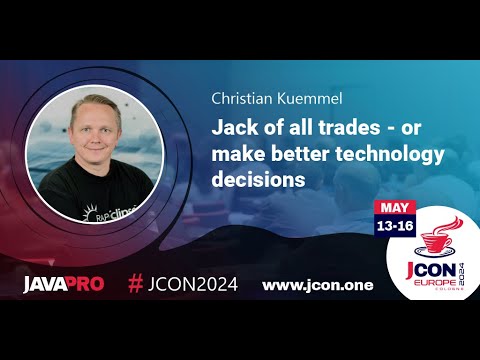
summary
Argues against hunting an “egg‑laying jack of all trades” and gives concrete tradeoffs: choose Vaadin + RapidClipse front end, Micronaut/MicroStream/EclipseStore for state, Lucene for search, and AWS S3 for binaries; move archives off the primary DB. Recommends a sweet spot of 500–5,000 users, warns that stateful scaling is insanely expensive, notes an Allianz deployment that grows from ~100 to ~2,000 concurrent users and 40GB to 300GB while staying mostly Java and working well.
AI-written summary · about
chapters (17)
- 0:00Introduction and speaker background
- 2:28Why most projects fail
- 4:37Perfectionism vs progress
- 6:44CAP theorem and scalability myths
- 8:34WhatsApp's simple architecture
- 10:01Balancing extremes in IT
- 11:25Choosing UI technologies
- 12:30User growth and infrastructure
- 16:03Storage strategies for large data
- 19:38Avoiding scalability traps
- 21:06Modules vs microservices
- 23:59Stateless vs stateful scaling
- 27:07Costs of Kubernetes complexity
- 29:38Case study: Alliance Insurance
- 32:32Keep it simple approach
- 33:14Microservices and monoliths
- 35:48Q&A and closing
related talks
 51mReal World Lean Java Practices, Patterns, Hacks, and Workarounds
 33mFrom Enterprise Architecture to Software Design - Critical Thinking
 29mWhen Web Scale Doesn't Make Sense
 46mDigital scale-up architectural patterns
 25mThinking Architecturally
 27m“Good Enough” Architecture Part 2
 31m“Good Enough” Architecture Part 1
 01h 02mTools for simplified large scale systems