Complementary Information and Learning Traps

summary
Model uses linear Gaussian signals (K latent states, one payoff‑relevant omega, N signal types) and agents sequentially choose a single source to minimize posterior variance with public realizations. Main claim is a sharp if‑and‑only‑if: long‑run outcomes concentrate on an informational set exactly when that set is strongly complementary; otherwise persistent learning traps arise and long‑run sampling can miss the optimal S star and its frequency lambda star. Speed losses are unbounded; under perfect persistence payoff difference is zero but small state autocorrelation creates large welfare losses. Interventions that allocate B observations across signals work if B is large, while merely increasing one signal’s precision may not.
AI-written summary · about
chapters (12)
- 0:00Introduction
- 2:06Informational Environment
- 3:32Interpretations of Payoff-Irrelevant Terms
- 5:43Decision Environment
- 9:37Example: Learning Trap
- 12:51Example: Efficient Learning
- 14:39Plan for Talk
- 15:12Definition: Complementary Sets
- 17:56Informational Value of Complementary Sets
- 24:37Another Example: Disjoint Communities
- 25:45Converse: Efficient Information Aggregation
- 33:27Characterization of Long-Run Outcomes
related talks
 45mTAP Free Energy, Spin Glasses, and Variational Inference
 59mTesting Assumptions of Learning Algorithms
 48mComputational-Statistical Tradeoffs in Robust High-Dimensional Estimation
 44mA Modern Maximum-Likelihood Theory for High-Dimensional Logistic Regression
 44mInvariance, Causality and Novel Robustness
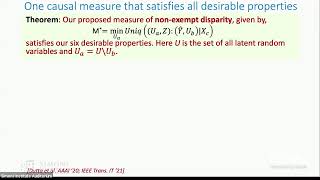 14mFair And Reliable Machine Learning For High-Stakes Applications:approaches Using Information Theory
 45mThe Statistical Fairness-Accuracy Frontier
 43mToward Human-Centered Machine Learning