Describing Microservices using Modern Haskell (Experience Report)
summary
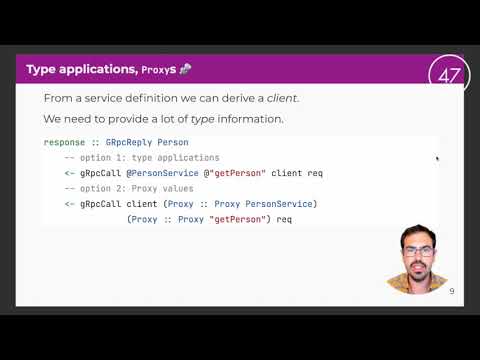
Mu (new-haskell) is a Haskell DSL that generates type-level schemas from industry IDLs like Protocol Buffers and Avro, targets gRPC and GraphQL transports, and uses Template Haskell, generic programming and attribute grammars to produce compile-time-checked message and service types. It successfully runs real RPC servers and clients, but reveals practical pain points: ergonomic holes around type applications/proxies, brittle GADT-style APIs that produce inscrutable errors, and the lack of local abstraction for type-class-based compile-time computation, which forces duplication and fragile instance ordering.
AI-written summary · about
chapters (5)
related talks
 46mPainless software development with Haskell
 38mMicroservices in Go using Micro
 21mProduction Haskell Demystified
 27mSimplifying Building and Managing Microservices with Micro
 38mMonolith vs. Microservices
 24mExecuting Microservice Applications on Serverless, Correctly
 38mMicroservices, a bittersweet symphony
 23mMicroservices – Sean Smith