Writing Highly Concurrent Polyglot Applications with Vert.x

summary
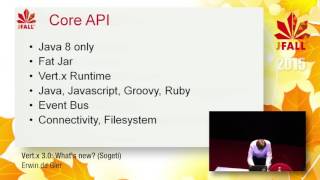
Vert.x is a JVM toolkit that runs single-threaded verticles communicating over a clustered event bus that spans JVMs and browsers; the demo shows an HTTP sender, a Java receiver and a browser bridge all talking in seconds. Version 3 focuses on being embeddable, auto-generating JavaScript/Ruby/Groovy APIs from Java, adding distributed map/lock/counter primitives, HA via quorum and Hazelcast by default, RX/Reactive Streams interop, and packaging as a runnable fat JAR. Benchmarks place it near the top for simple HTTP throughput.
AI-written summary · about
chapters (16)
- 0:00Introduction
- 2:17Current Status
- 2:52What is Vert.x?
- 5:45Polyglot
- 6:33Core Asychronous APIs
- 7:54Why Asynchronous?
- 17:24Clustered Event Bus
- 18:52Event bus in the Browser
- 25:33Running verticles
- 29:37High Availability
- 31:10Code Generation
- 36:25Distributed Data
- 38:39Management and monitoring
- 39:29Official stack
- 41:14Summary
- 43:39Project Info
related talks
 55mVert.x - wydajna i skalowalna platforma
 47mModern app programming with RxJava and Eclipse Vert.x
 01h 01mExploring Vert.x in Java, Groovy, and JavaScript
 01h 01mReactive Microservices on the JVM with Vert.x
 33mCrushing Application Latency with Vert.x
 38mVertx.io and MQTT: Asynchronous in the Internet of Things
 46mVert.x 3.0: What's New?
 45mBuilding microservices with Vert.x