Story Driven Development: The Next Generation of Rails Functional Testing
summary
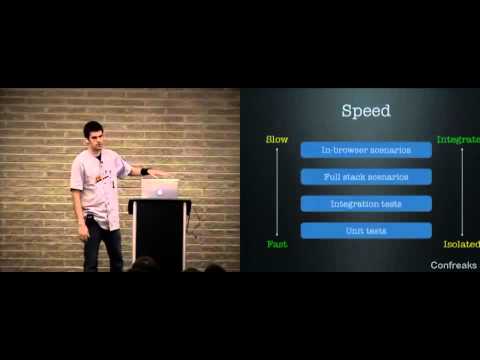
Shows how user stories become executable acceptance tests using the rspec story runner, with examples (a CV-tracking app and the duplicate “Zed Shaw” case) and a clear red‑green‑refactor workflow. Demonstrates three implementation styles: direct object access, full Rails integration with Webrat, and full‑browser checks with Selenium, discusses tradeoffs (coverage vs speed) and how to avoid brittle assertions, and reports a real suite of about 250 scenarios in ~2 minutes on the CI server.
AI-written summary · about
chapters (15)
- 0:00Introduction to challenges
- 2:31Problems in development
- 5:34Benefits of story-driven
- 7:35Defining the story format
- 11:06Stories vs agile practices
- 13:23Declarative vs imperative
- 15:03RSpec story runner
- 18:22Direct vs full stack
- 21:09Webrat for simulation
- 25:59Combining testing methods
- 29:35Testing food pyramid
- 31:25Workflow and lifecycle
- 33:56Live demo and iteration
- 38:31Conclusion and resources
- 41:20Q&A session
related talks
 39mStop Testing, Start Storytelling
 01h 19mBDD and Acceptance Testing with RSpec & Capybara
 01h 00mBehaviour Driven Development with RSpec
 27mUnderstanding Rails test types in RSpec
 27mThe TDD Treasure Map
 54mTDD Workshop: Outward-in Development, Unit Tests, and Fixture Data
 47mTelling Better Stories with Tests
 27mTDD on the Shoulders of Giants