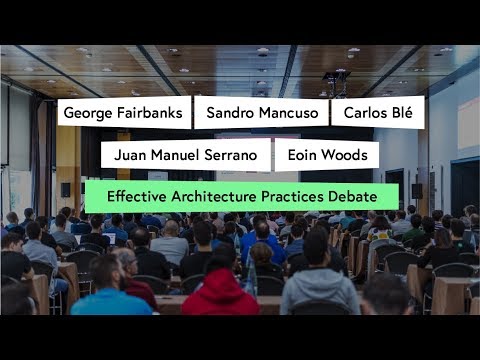
Effective Architecture Practices Debate
summary
Debate argues that effectiveness means meeting stakeholder outcomes while efficiency minimizes waste, illustrated by the failure of Friendster caused by a single MySQL bottleneck that killed performance and user retention. Model-driven architecture largely fails, but modern App Engines and DevOps declarative pipelines act like practical DSLs; Spark’s RDDs function as a real example of an embedded DSL. Practical advice: run early proofs of concept, make architecture testable, isolate risky areas (for example separate payment service for PCI), and map stakeholders plus three views: source, runtime, deployment.
AI-written summary · about
chapters (33)
- 0:00Introduction to effectiveness
- 1:10Effectiveness vs efficiency in architecture
- 2:38Failure as a critical factor
- 4:05Architects as risk managers
- 6:34Model-driven architecture pitfalls
- 7:57Modern frameworks as DSLs
- 9:21Code generation in critical systems
- 10:43Domain-specific languages potential
- 13:10Architecture in programming languages
- 15:59DevOps as architectural expression
- 17:08Business components in code
- 18:56Limitations of current languages
- 20:40Academic and industrial divide
- 22:52Bridging research and practice
- 24:36Validating architecture effectiveness
- 26:00Future-proofing architecture decisions
- 27:50Validation criteria for architecture
- 28:52Cost of architectural decisions
- 30:19Agile architecture practices
- 32:30Architecture as continuous process
- 34:17Parnas and future-proofing code
- 36:05Over-engineering risks
- 37:29Big design up front vs no design
- 39:16Cost of undoing generalizations
- 41:03Balancing abstraction and coupling
- 42:52Enterprise vs solution architecture
- 45:45Layered architectural constraints
- 47:30Speed of architectural decisions
- 47:52TDD and architecture connection
- 50:43Defining software architecture
- 53:14Teaching architecture practices
- 56:45Three primary architecture views
- 57:06Actionable architecture improvements


