Improving customer experience through journey...
summary
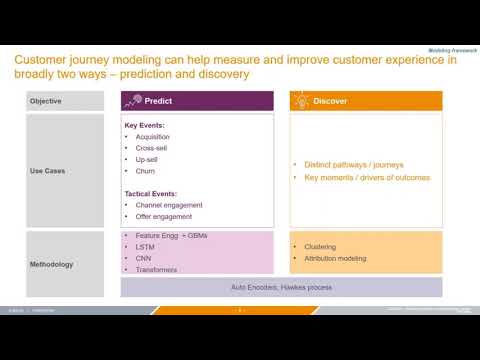
A deployed pipeline converts event sequences into LSTM embeddings that predict the next interaction and a realtime NPS proxy so the system flags customers likely to call and either prompts on‑site help or preloads agent screens to improve first‑call resolution. The stack uses sequence representation plus autoencoders for clustering and a Hawkes process to filter high‑impact events; applied to telecom (churn, upsell, call prediction) and healthcare (patient pathway discovery) with production pilots showing practical operational gains.
AI-written summary · about
chapters (8)
- 0:00Srinivas Chilukuri
- 1:12Customer experience evolves and is reflected through various interactions they have through the course of their journey
- 2:40The richness of customer data while is desirable, poses severe algorithmic and computation challenges in analyzing customer journeys and quantifying experience
- 4:46The standard approaches for interpreting customer journeys have limitations. Al comes to the rescue
- 6:58Customer journey modeling can help measure and improve customer experience in broadly two ways - prediction and discovery
- 11:17We can define a unified model architecture that supports both predictions and discovery
- 14:28Predictive estimation of customer satisfaction enables proactive intervention
- 17:19Along with predicting the event of interest, different types of interactions can be clustered in different groups using the embeddings
related talks
 37mRole Of AI In Consumer Interaction
 32mHarnessing Large Language Models for Enhanced Customer Experience
 30mDriving a Higher Level of Customer Support with Machine Learning
 25mRevolutionizing Customer Experience Through AI & Data
 38mUsing Recurrent Neuronal Networks for Customer Predictions
 27mUsing GenAI with Audio Data for Driving Better Customer Experience
 29mProcess Optimization using AI/ML
 23mContact Center Voice AI: Low-Latency Intelligence Extraction from Messy Audio Streams