Total Massacre: Reducing the Middle Office
summary
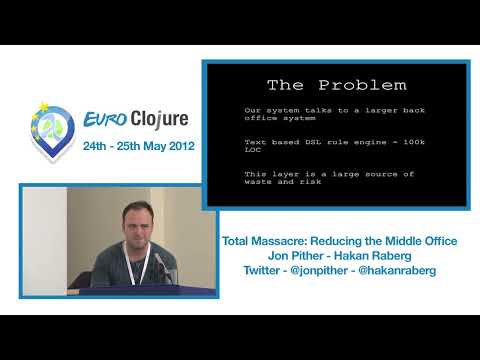
A small pod of engineers introduces Clojure into a London bank to replace a wasteful feed layer that sits between a 1 million lines of Java monolith and a legacy back-office, aiming to convert two large maps into one. Built a Clojure mapping/rule engine plus a Noir reconciliation app, deployed as an OSGi/uber-jar inside Tomcat, using ElasticSearch for ad hoc queries and Clojure concurrency primitives (futures, agents). The result is about 10k lines of Clojure, frozen real-event tests with HTML reports, and the system is in production since March.
AI-written summary · about
chapters (14)
- 0:00Introduction
- 2:17Monolith problem in middle office
- 6:55Clojure over incremental changes
- 9:45Legacy Java rule engine mess
- 14:58Elasticsearch as data layer
- 17:03Simplifying position counting
- 19:07First Clojure rule engine
- 21:11Deploying Clojure in Java monolith
- 22:37Clojure concurrency benefits
- 24:00Testing with FitNesse
- 26:07Structuring Clojure code challenges
- 28:13Clojure in production
- 30:47Cultural shift and Emacs
- 31:30Future Clojure plans
related talks
 40mLessons Learned Creating a Successful Machine Learning Startup with Clojure
 34mDeepen and Diversify the Clojure Community with Jr Engineers
 37mTeaching Clojure at IBM
 17mBetting the company on Clojure
 44mLearning and Teaching Clojure on the job at Amperity
 26mStaying ahead of the curve
 41mAdapting Clojure to an Intro CS Classroom
 51mWhere to Start?