Mria: an eventually consistent Mnesia

summary
Mria is an extension to Mnesia that trades strict serializability for eventual consistency within a cluster by splitting the cluster into small core nodes and read-only replicants, moving writes to cores and eliminating cluster-wide broadcast on every commit. Bootstrapping uses a bootstrap with buffered real-time transaction log so a replicant backfills without blocking and then applies buffered transactions to converge. Validation uses ConcuR, trace-based chaos tests, small-scale formal proofs and netem benchmarking; results show much better horizontal scalability and scaled EMQX to 23 nodes, 100M simultaneous sessions.
AI-written summary · about
chapters (8)
- 0:00Introduction
- 1:07MQX and Mnesia context
- 5:06Mnesia replication limits
- 10:58Maria goals and design
- 16:45Replicant state machine
- 21:05Performance benchmarks
- 25:03Outcomes and next steps
- 25:44Q&A
related talks
 26mMria - an eventually consistent Mnesia
 40mKhepri - Mnesia replacement
 37mBreaking up with Mnesia
 12mFault-Tolerant Replication with Pull-Based Consensus in MongoDB
 19mMemento: A Framework for Detectable Recoverability in Persistent Memory
 41mConsistent, Distributed Elixir
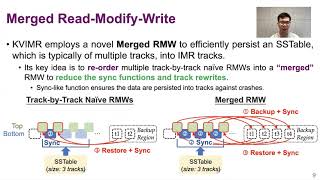 15mKVIMR: Key-Value Store Aware Data Management Middleware for Interlaced Magnetic...
 49mmnesia + leveldb (...)