Why did I create Salt?
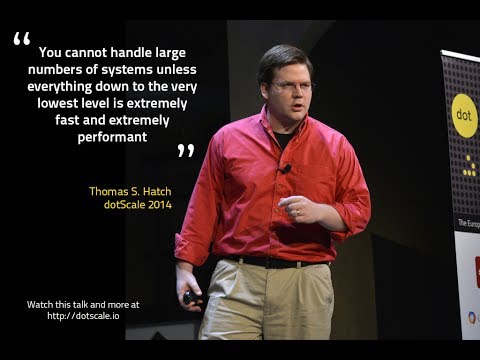
summary
Salt (SaltStack) claims concrete results: benchmarks dramatically faster than competitors, scales to tens of thousands of nodes, and uses an asynchronous communication bus plus a normalized library to manage Linux, Windows, OS X, Docker and LXC and public and private clouds. Configuration is both declarative and deterministic, data-driven, and event‑aware; the platform exposes roughly 18 module insertion points and is credited with rapid mitigation of incidents such as Heartbleed.
AI-written summary · about
chapters (15)
- 0:00Intro
- 1:00Unified approach
- 3:45Snowflake servers
- 5:37Minions
- 6:15Communication
- 6:52Scale
- 7:34Normalized
- 8:33Cross management
- 8:51Modular layered
- 9:49Configuration management
- 10:59Imperative
- 11:49Declarative
- 13:08Autonomic
- 14:24Environments
- 15:13Events
related talks
 19mWhy did I create Salt?
 39mBeyond Open Source Configuration Management: Rapidly Building Any Cloud at Scale
 51mBuilding Web Scale Using Open Source on the Internet Assembly Line
 58mIntroduction to
 52mScalable Systems Management with Salt
 30mThe Evolution of DevOps Automation
 40mSalt: How to be Truly Lazy
 37mSalting things up in the sysadmin's world