Django as a Database Documentation Tool: The Hidden Power... with Ryan Cheley
summary
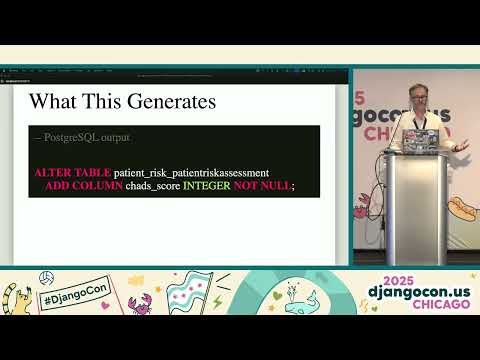
Introduces Django 4.2 features that write model DB comment and DB table comment into Postgres via migrations so documentation lives in the schema; demonstrates CHA2DS2‑VASC score (0–9, >2 → anticoagulation consideration per 2010 ESC), JSON keys warn_allergy bleeding_disorder pregnancy_status as booleans, and shows Redgate extracting comments into HTML. Recommends auditing top 10 confusing fields, adding business logic and regulatory notes, and optionally enforcing comments with linters or tests.
AI-written summary · about
chapters (16)
- 0:00Django as DB documentation
- 1:47Undocumented fields risks
- 4:20Database docs pain points
- 6:50Why help text fails
- 9:38Stakeholders' needs
- 10:19Django 4.2 DB comments
- 11:44DB comments with migrations
- 12:48Self-documenting models
- 14:13JSON fields for ETL
- 15:36Table-level comments
- 17:01Implement DB docs steps
- 19:29Conclusion & benefits
- 19:53Q&A: Enforcing DB comments
- 20:38Q&A: Help text vs DB comments
- 21:40Q&A: Generated docs with DB comments
- 22:21Q&A: Documenting choice fields
related talks
 21mDjango and PostgreSQL: An Even-Closer Union
 22mDjango with PostgreSQL superpowers
 23mDjango with PostgreSQL superpowers
 21mDjango's Migrations: A Retrospective
 57mDjangoCon 2008 Panel: Schema Evolution
 31mSpace Django: Migrating and Redesigning a Database while Hunting for Satellites.
 19mData internationalization in Django
 43mDigging Into Django's Migrations