Moving beyond DevOps with automated cloud-native platforms
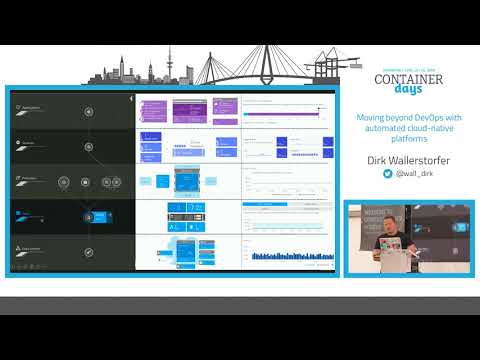
summary
Claims that many orgs only have 5% visibility into complex cloud-native stacks and that a five-stage path — visibility, microservices/cloud migration, safety nets, auto-remediation, full automation — closes the gap. Shows a working pattern: an unbreakable pipeline built on AWS CodePipeline + Lambda that compares performance against the last build and auto-rejects or rolls back, and uses Ansible Tower to run remediation playbooks. Outcome: self‑healing deployments, fewer 2 a.m. wakeups, and measurable KPIs like faster push-to-production times.
AI-written summary · about
chapters (12)
- 0:00Introduction to future DevOps
- 2:17Current DevOps landscape
- 4:05Challenges of 100% visibility
- 6:12Five stages of cloud operations
- 8:05Stage 1: Increasing visibility
- 11:00Stage 2: Cloud migration and microservices
- 13:49Stage 3: Unbreakable delivery pipeline
- 18:30Stage 4: Auto remediation
- 21:18Stage 5: Autonomous cloud operations
- 23:04Business impact of automation
- 25:43Actionable next steps
- 28:59Q&A and closing
related talks
 01h 02mTransforming IT pros to DevOps gurus: Ssecure your new tech stacks
 28mContinuous everything: Moving to DevOps on AWS
 55mPatterns & Anti Patterns for Scaling & Enabling DevOps Adoption
 27mThe Five Phases of DevOps
 23mCI/CD at Scale: Best practices with AWS DevOps Services
 01h 02mTools and Techniques for Infrastructure as Code
 06mLow Growth DevOps
 33mFrom 0 to DevOps in 80 days