MLOps at Scale

summary
Claims that operationalizing models is the hard part and that MLOps prevents mission‑critical failures; cites a real credit‑risk model that misclassifies after COVID and a retail recommender that retrains daily. Describes a petabyte‑scale data warehouse and end‑to‑end pipelines using Airflow or QBFlow for automation, DVC and MLflow (or SageMaker) for dataset and model versioning, feature stores and prompt stores and shadow deployments for LLMs, plus red‑teaming, monitoring for hallucination/toxicity, and automated retrain triggers.
AI-written summary · about
chapters (11)
- 0:00Introduction and Speaker Background
- 0:58The Importance of ML Ops
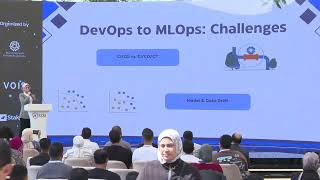
- 2:27Challenges in Traditional ML Projects
- 3:52What is ML Ops?
- 4:48ML Ops in the Era of Large Language Models
- 6:31ML Ops Lifecycle
- 7:53Automation in ML Ops
- 8:53CICD for ML and Large Language Models
- 9:54Governance and Responsible AI
- 10:49Monitoring and Best Practices
- 12:19Conclusion and Call to Action
related talks
 41mTHE STATE OF MLOPS - MACHINE LEARNING IN PRODUCTION AT ENTERPRISE SCALE
 53mExperience with an end-to-end MLOps pipeline: Practical insights and 3D architectural perspectives
 14mWhy Your DevOps Skills Are Your MLOps
 47mMachine Learning in Production: An Intro to MLOps.
 45mThe Culture, Architecture and Technology of MLOps
 15mOperationalizing Predictive Analytics in Education
 43mNavigating the MLOps Journey: Key Considerations for Successful Implementations
 01mMLOps: Applying DevOps to ML