Paul Barratt | AI Track | Compass AI & Data Summit 2025
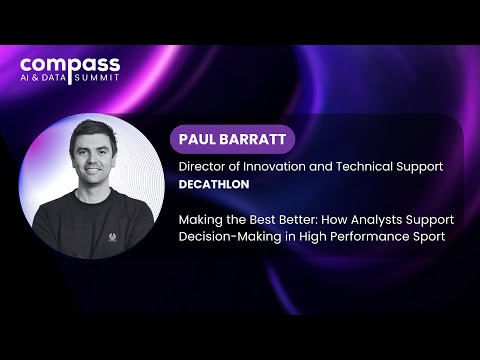
summary
Claims that broke or shifted performance: a sub-2 hour marathon combines 5% running economy shoes, GPS-controlled pace cars with laser guidance, CFD-optimized drafting formation, a resurfaced banked course and a weather window to hit exact conditions. Moneyball-style models focus on on-base percentage to hit targets like 95 wins. Formula 1 strategy uses Monte Carlo plus game theory. A genetic algorithm reorders team-pursuit rotations and saves seconds but fails if insight isn’t embedded — beware cargo-cult or naive analysis.
AI-written summary · about
chapters (20)
- 0:00Paul Barratt introduction
- 1:15159 marathon challenge
- 4:24Olympic to pro transitions
- 6:09Role of data analysts
- 8:16Sports analytics teams
- 10:00Traits for analytics setups
- 11:05Moneyball and baseball stats
- 13:33F1 race strategy analytics
- 17:02Cargo cult analysis pitfalls
- 19:54Resistance to new insights
- 24:08Team pursuit failure lessons
- 26:13Decision-making under uncertainty
- 27:40Wind tunnel vs real-world data
- 30:27Dangers of naive analysis
- 32:57Why analysts think like foxes
- 35:04Fast vs slow decisions in sport
- 39:13Communicating insights to athletes
- 40:59AI in elite sport now
- 44:11Ethics of athlete monitoring
- 46:40Q&A
related talks
 20mInnovating at speed
 16mData Driven Design at F1 Speed
 29mBecoming a data-driven enterprise
 40mFast Cars, Big Data - How Streaming Can Help Formula 1 #bbuzz
 36mHow can AI turn data overload into smarter decision-making?
 42mFast Cars, Big Data - How Streaming Can Help Formula 1
 17mFocus on Data, on the Road to AI
 06mData Driven Performance