Ethical Bias

summary
Claims that fully ethical AI is impossible now but practical progress comes from design choices: a communication-focused agent prototype learns from users while keeping data local by using almost 50% of devices with AI acceleration to do on-device preprocessing, reducing network exposure. The approach codifies five enforceable constraints — safety, fairness, human oversight, transparency, accountability — and adds worker rights, bias tagging, and shared responsibility for detection and mitigation; experiments emphasize reduced data flow and increased user trust rather than perfect bias elimination.
AI-written summary · about
chapters (12)
- 0:00Ethical AI challenges
- 1:27McLuhan’s tool shaping humans
- 2:09Ethical issues in AI today
- 3:54Ethical frameworks and oversight
- 4:37AI bias: sources and types
- 6:21On-device AI for privacy
- 8:05Five pillars of ethical AI
- 9:30Communication pitfalls in AI
- 12:04Root causes of bias
- 13:53Rethinking AI communication
- 15:19Building trust in AI
- 16:44Q&A
related talks
 05mToward Ethical AI
 34m(Un)Ethical Machines? Why AI Bias Is a Problem and What to Do About It
 16mMachine Intelligence With Humans in Mind
 32mSo you want to develop ethical AI. What does that mean in practice?
 43mWhat You Always Wanted to Ask About Ethics in AI
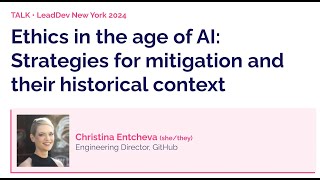 21mEthics in the age of AI: Strategies for mitigation and their historical context
 19mMoral Outsourcing: Humanity in the age of AI
 26mBuilding ethical AI: Transparency, bias mitigation, and trust