UniK: Unikernel Backend to Cloud Foundry

summary
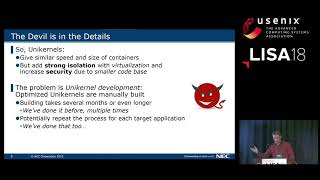
UniK provides a backend that compiles an application plus only the libraries and drivers it needs into a bootable unikernel image (AMI/VM or bare metal), integrates with Cloud Foundry as a Diego backend, and manages scheduling and health. The demo shows cf push producing a unikernel, the UniK daemon talking over Docker API compatibility, scaling to 3 instances, and a Raspberry Pi toaster demo (ARM support); images are small (a 300MB DNS image), boot as fast as containers, are single-user (no fork), and the project is open source with ~299 GitHub stars.
AI-written summary · about
chapters (19)
- 0:00Introduction
- 0:40Cloud Foundry Stack
- 4:50Security
- 5:48Linux Kernel
- 6:10Source Code
- 7:04How did we get there
- 7:32What can Linux run
- 7:51Compatibility vs Efficiency
- 8:03Performance
- 8:27UniK
- 10:27UniK Advantages
- 13:29What did we do
- 14:24How does it work
- 17:05ARM Support
- 17:24Docker API
- 17:56Demo
- 23:33Demonstration
- 27:45Scaling
- 29:49Testing
related talks
 38mUnik & Cloud Foundry Integration: Focus on IoT
 23mIt’s Time to Debloat the Cloud with Unikraft
 38mUnikernels: The Next Evolution in Cloud Infrastructure
 39mUnikraft Has Arrived: The Lightweight, Fast, Usable Solution for Cloud Deployments
 07mLightning Talk: Love at First Sight, Unik & Serverless
 35mUnikraft: Unikernels Made Easy
 25mRunning Unikernels in Prod for a Few Years
 33mUnikernels and Explorations