Wiring Prismatic's API with
summary
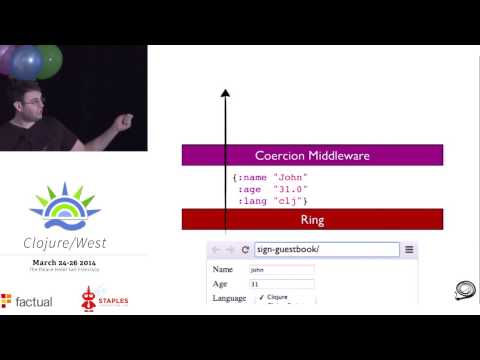
Defines how annotated Clojure functions become production APIs by using Plumbing and Schema annotations that fnHouse reads to emit handler metadata, live documentation, a simple router and a ring middleware that coerces JSON string inputs into longs and keywords. Shows a working stack that validates inputs and outputs at runtime, reduces boilerplate, and keeps clients in sync by generating Objective‑C and ClojureScript models with Coax, used successfully at Prismatic.
AI-written summary · about
chapters (27)
- 0:00Intro
- 1:59Guts of a Request
- 3:13Handler as Function
- 4:42Keyword Functions
- 5:24defnk Input Validation
- 6:23defnk Default Args
- 7:39Guestbook Handler
- 9:06Schema for Valid Inputs
- 9:41Schematize Input Args
- 10:35Schema Validation
- 11:29Global Resources
- 13:27fnhouse Handler
- 15:44Annotated Handler
- 16:19Docs for Handlers
- 16:49Link to Source
- 17:10Swagger
- 18:11Routing
- 19:30Applications
- 21:37JSON Parsing Errors
- 22:11Coercion Middleware
- 23:16Output Coercion
- 23:38Server vs Client Entry
- 24:21Output Coercer
- 27:09Generate Client Code
- 28:07Schema Extensions
- 28:56Customizable
- 31:13Questions?
related talks
 29mConjure: simple, polyglot RPC
 27mPowerful Data Access in Clojure
 39mFunctional APIs with GraphQL & Elixir
 01h 12mAPI Abstraction and API Chaining in Grails
 40mSticky API: Connect Bricks and enter a global IT-ecosystem
 20mRevolutionizing API Management: Insights from an Architect
 24mGraphQL, gRPC, REST, Oh My! - A Method for Unified API Design
 35mShow Me the Schema! RPCs and Learning to Love Code Gen