Homoiconicity It Is What It Is
summary
Defines homoiconicity as the requirement to write program code as literal data structures and to have a reader that returns data without evaluating it, not just an eval hack. Traces the coinage to the 1965 Track paper and links Lisp, Tcl, Prolog and XSLT as practical examples. Demonstrates tooling by parsing a WARC archive with a tiny HTTP server and by generating a presentation from slide deck as Clojure maps using spec and EDN.
AI-written summary · about
chapters (27)
- 0:00Introduction
- 0:17Dictionary definition
- 1:49C2 wiki
- 2:08Web Archive
- 2:39HTTP Server
- 4:14Commonlisp
- 5:14Tickle
- 5:57Java
- 7:21Origin
- 7:37Track
- 8:25Expression
- 9:40Fibonacci Function
- 10:11FreeMax
- 10:35Mint
- 11:23Interpreter
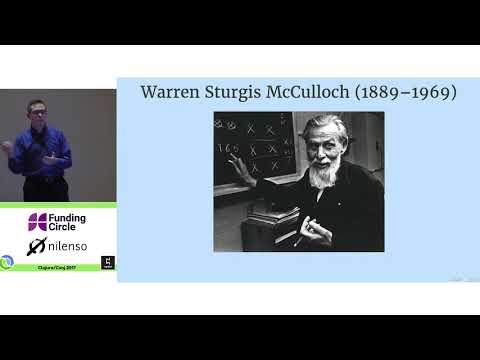
- 12:28McCullough
- 13:04Charles Sanders Purse
- 15:02Homoiconicity
- 18:22Alan Kay
- 22:18JavaScript
- 22:47Cloud Formation
- 24:56Slide Deck
- 26:53Embedded DSLs
- 27:21Go
- 28:37Embedded ESLs
- 29:24Examples
- 30:20Outro
related talks
 30mAdventures in homoiconicity
 27mEmbedding by Unembedding
 01h 31mFrom C to Comonads to Climate: A Functional Programmer's Journey in Array Programming(…)
 39mSimplicity for Programmable Money
 01h 06mVerifying a compiler through equational means
 28mElements of Logic Programming in a Concatenative Functional Language
 39mWhat Counts as a Programming Language
 27mReclaiming the Unexplored in Hybrid Visual Programming