AI Assisted Load Sharing for Improved Energy Efficiency

summary
AI builds a physics‑aware digital twin of a five‑compressor air supply for two clarifiers, fits thermodynamic parameters to historical and real‑time pressure/temperature/flow data, then runs evolutionary algorithms to output control rules—which compressor to run and exact setpoints for lowest power. Claimed savings rise from an initial 4.5% estimate (~34,000 kWh/month) to an outcome above 42,000 kWh/month; model validation against past operation and a human‑in‑the‑loop for explainable recommendations support deployment.
AI-written summary · about
chapters (14)
- 0:00Introduction
- 1:01Industrial Analytics and AI services
- 2:26Energy-intensive industry challenges
- 3:52AI for industrial optimization
- 4:55Digital twin for load balancing
- 5:37Case study: compressed air optimization
- 7:03Energy efficiency potential
- 8:07Model training strategy
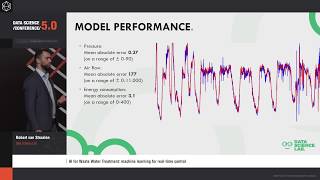
- 9:12AI model results
- 10:15Q&A
- 12:02Human-in-the-loop decisions
- 14:31Quality assurance and regulations
- 15:14B2B customer acquisition
- 17:00Closing remarks
related talks
 30mAI for Waste Water Treatment
 21mApplication of AI technologies in nuclear power plants
 31mAI-supported transformation of the urban infrastructure
 28mAI vs Climate Change: Insights from the Cutting Edge
 26mTowards an AI Assistant for Tertiary Voltage Control
 19mResource Management Innovation for AI Workloads in Cloud Computing
 26mAI-Powered Predictive Analytics: Optimize Performance
 26mAI will drive the industrial IoT to the cloud