Using Defects in Solids for Quantum Computation

summary
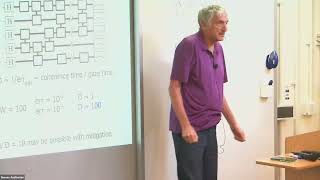
Defect-based NV centers in diamond use a central electron spin coupled to nearby 13C nuclear spins (natural abundance more than 70 coupled carbon spins reported) and operate at room temperature. The core claim is that an engineered synchronization effect converts off-resonant-drive errors into high-fidelity, fast electron–nuclear gates instead of using very weak long pulses. Implemented multicubit controlled rotations exploit central-spin connectivity to encode a repetition code and produce lower logical error rates than comparable superconducting implementations across tested parameters.
AI-written summary · about
chapters (10)
- 0:00Quantum computation with solids
- 1:04Useful quantum registers
- 3:14Quantum hardware challenges
- 3:58NV center structure
- 6:27Nuclear spin cubits in NV centers
- 7:11Electronuclear entangling gate
- 8:37Errors in quantum systems
- 11:25High-fidelity gate synchronization
- 13:12Error correction with bit-flip codes
- 15:02Central spin connectivity
related talks
 01h 10mArchitectural mechanisms of a universal fault-tolerant quantum computer
 33mAtomic Quantum Processors and the Error-Correction Frontier
 28mThe Problem with Qubits
 28mAnalog and Digital Quantum Computing with Neutral Atoms
 01h 01mInvited Talk: Welcome to Quantum 3.0!
 56mWhat is Your Logical Qubit?
 49mExploring the quantum computing frontier with reconfigurable atom arrays
 46mProbing the limits of classical computing with arbitrarily connected quantum circuits