Standardizing Zero Knowledge Proofs - Keynote

summary
Defines concrete targets: standardize common reference string and the threat model for a trusted setup, specify which proof classes must be supported (non‑interactive succinct proofs with PCP backends), and require explicit assumptions and composability guarantees. Calls for agreed benchmarks (proof size, prover/verifier time, witness size), mandated code review/formal checks, and clear APIs between compiler, PCP/arithmetic representation, and proof-generator so different implementations can interoperate.
AI-written summary · about
chapters (19)
- 0:00Intro
- 1:22Zero Knowledge
- 2:20Proof
- 3:08Proof is good
- 5:03Proofs for Collaboration
- 7:54Security
- 9:03Mobility
- 10:03Common Record String
- 16:49The Natural Next Step
- 18:40Parameters
- 21:55Systems
- 25:05Why standardized
- 27:25Benchmarking
- 29:25Security Standards
- 31:35Interactive Knowledge
- 33:55Transferability
- 34:55Cryptographer
- 35:42Standardizing Security
- 39:25Standardizing Knowledge
related talks
 35mEfficient Zero Knowledge Protocols: The Modular Approach
 20mThe Evolution of ZKProof.org
 41mGKR based Zero-Knowledge Proofs
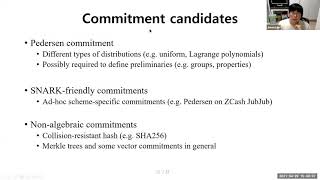 59mCommit-and-Prove Zero-Knowledge Proof Systems and Extensions
 26mApplications of Zero Knowledge Proofs in the Banking Industry
 44mBilinear Pairings-based Zero-Knowledge Proofs
 51mDistributed Zero-Knowledge Proofs and Applications to Secure Computation
 51mWhy you shouldn't trust me